You come back to the car. The window is broken. The console is open. The firearm is gone.
The next few steps matter. Get somewhere safe, contact local law enforcement, preserve what you can, and give investigators every identifying detail available.

ATF's federal theft-reporting process applies differently to federal firearms licensees. A private owner should report the theft to local law enforcement and follow any applicable state or local reporting requirements.
Start with the scene.
If you discover a vehicle break-in, make sure you are safe before doing anything else. If there is an immediate threat, follow emergency-dispatch instructions.
Do not start moving things around simply to see what else is missing. The responding agency may want the vehicle left as found while officers document the break-in.
Once law enforcement tells you how to proceed, provide the theft location, the time window, what was taken, and every identifying detail you have for the firearm.

A stolen firearm with a documented report and identifying information gives investigators something specific to work with if the firearm is later recovered.
The steps, in order.
Use the emergency number if there is an immediate danger. Otherwise follow the local agency's reporting instructions.
Avoid disturbing the vehicle until law enforcement tells you what they need documented or preserved.
Give investigators the manufacturer, model, caliber or gauge, serial number, photographs, receipt, and purchase information you have available.
Keep the agency name, investigating officer information if provided, and the report or case number together.
Private-owner reporting rules can vary by jurisdiction. Follow the current requirements that apply where the theft occurred and where you live.
Why the report matters.
Everytown's analysis of 337 cities found nearly 62,000 guns were reported stolen from vehicles in 2022. Across the cities studied, that worked out to approximately one reported firearm theft from a vehicle every nine minutes.
That is one reason identifying records matter. A police report tied to the firearm's serial number creates a record that investigators can use if the firearm is later recovered.
A report also gives you documentation that may be needed later by an insurer or another investigating agency.
Record firearm information before you need it.
The easiest time to look for a serial number is not after the firearm has disappeared.
Create a private inventory for the firearms you own. At minimum, record the manufacturer, model, caliber or gauge, and serial number.
Keep purchase records and useful photographs in a secure location that is separate from the firearms themselves.
The point of an inventory is to still have it when something else is lost or stolen. Keep the records somewhere you can access independently.
What if you do not know the serial number?
Tell the investigating agency what information you do have and contact the dealer where the firearm was purchased.
Do not guess at the number. Give law enforcement accurate information and follow their instructions for locating qualifying purchase or transaction records.

Insurance and follow-up.
If you have homeowners, renters, auto, or specialty coverage that might apply, review the policy or contact the carrier directly.
Coverage varies. Do not assume a firearm, vehicle break-in, damaged window, or stolen personal property is automatically covered under a particular policy.
Keep the police report, purchase documentation, photographs, repair receipts, and insurance correspondence together while the case is active.
Preventing the next one.
You cannot eliminate every theft attempt. You can give an opportunistic thief more work to do.
Keep the firearm out of sight.
A visible firearm, case, holster, or obvious lockbox can advertise that something valuable is inside the vehicle.
Use a real lock.
When a firearm must lawfully remain in a vehicle, store it unloaded in a dedicated locked container rather than leaving it loose in a console, bag, or other predictable location.
Attach the container.
A loose lockbox can still leave with the thief. Connecting the safe to the vehicle adds another layer between a break-in and removal of the container.
Minimize unattended time.
A vehicle safe is a storage layer, not permission to leave a firearm unattended indefinitely. Move it to more appropriate secure storage when practical and lawful.
Where Boosted Safe fits.
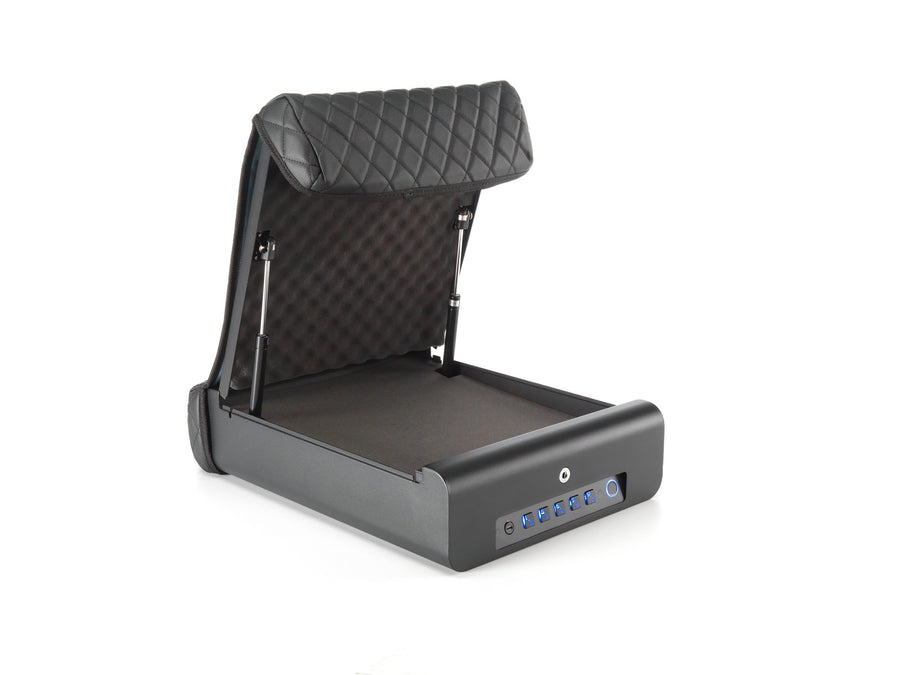
The Boosted Safe Elite is a full-size steel vehicle safe designed to connect to compatible child-seat anchors in the rear of the vehicle.
Its cover disguises the safe as a booster seat. Inside, the Elite provides fingerprint, keypad, and key access.
The idea is simple: keep the container from advertising itself, lock the firearm inside, and connect the safe to the car instead of leaving a portable box loose in the cabin.
No safe is theft-proof and we will never say otherwise.
Before choosing a model, check vehicle fit and confirm the intended seating position and anchor access.

Keep these records.

If a firearm is stolen from your car.
- Move to a safe location.
- Do not disturb the vehicle until instructed.
- Contact local law enforcement promptly.
- Provide the manufacturer, model, caliber or gauge, and serial number.
- Provide photographs and purchase information if available.
- Obtain the case or report number.
- Follow applicable state and local reporting requirements.
- Contact the purchasing dealer if identifying information is missing.
- Preserve receipts, photographs, repair records, and insurance correspondence.
- Review the vehicle-storage routine after the immediate report is complete.
Frequently asked questions.
Should a private owner report a stolen firearm directly to ATF?
ATF's federal theft-reporting process is different for private owners and federal firearms licensees. A private owner should report the theft to local law enforcement and follow applicable state and local requirements.
Does the federal 48-hour ATF reporting rule apply to a private owner?
The federal 48-hour theft-or-loss reporting requirement referenced by ATF applies to federal firearms licensees. Private-owner reporting duties can depend on state and local law.
What information should I give police?
Provide the manufacturer, model, caliber or gauge, serial number, available photographs, receipt or purchase information, and the circumstances of the theft.
What if I do not know the serial number?
Tell the investigating agency and contact the dealer where the firearm was purchased. Do not guess at identifying information.
Should I file an insurance claim?
Review your policy and ask the carrier what coverage and documentation apply. Coverage varies by insurer and policy.
Can a vehicle safe prevent another firearm theft?
No. No safe is theft-proof. Concealment, locking, attachment, vehicle security, parking choice, tools, and unattended time all affect the outcome.
Where should I keep my firearm inventory?
Keep it somewhere secure and separate from the firearms themselves, with access that does not depend on the vehicle or another item that could be lost in the same incident.
Make the next theft harder.
Conceal the container. Lock the firearm inside. Attach the safe to the vehicle. And record the serial number before you ever need it.
Sources and official references.
Federal guidance on reporting firearm theft or loss.
Open ATF guidanceInformation about records-search requests used in qualifying investigations.
Open ATF resourceResearch on firearm-theft trends and vehicle theft patterns.
Open sourceResearch on reported firearms stolen from vehicles.
Open sourceThis article is for general informational purposes only and is not legal advice. Firearm theft, loss, possession, reporting, transportation, and storage requirements vary by jurisdiction and can change. Follow law-enforcement instructions and verify current state, local, and federal requirements that apply to your situation.